The Novelist

Just stumbled across a new game called The Novelist:

From The Novelist website:

The Novelist asks one central question: can you achieve your dreams without pushing away the people you love? The game focuses on Dan Kaplan, a novelist struggling to write the most important book of his career while trying to be the best husband and father he can be. The Kaplans have come to a remote coastal home for the summer, unaware that they’re sharing the house with a mysterious ghostly presence: you.

Read the family’s thoughts. Explore their memories. Uncover their desires and intervene in their lives. But stay out of sight; you can’t help the Kaplans if they know there’s a ghost in the house. It’s up to you to decide how Dan’s career and family life will evolve, but choose carefully; there are no easy answers, and every choice has a cost.

Dan’s relationships – to his work, his wife, and his son – react and shift in response to your choices. With a different sequence of events in every playthrough, The Novelist gives life to a unique experience each time you play.

The decisions you make will define the Kaplans’ lives, but they may also tell you something about yourself.

The Novelist screen 1

Obviously both the writer and gamer parts of me are pretty keen to play this, but so is the father part. The key question (whether as a writer you can achieve your dreams without pushing away the people you love?) is one I think any writer with a family struggles with. Time spent on your writing, particularly when writing is not your ‘real’ job, is time spent shutting yourself away from those most important to you. Finding a balance is not easy and a game that explores that idea makes a nice change from the usual identikit shooters out there. Plus, you play a ghost.

I’m also hoping that the screenshot below means you can spend hours just typing ‘All work and no play makes Jack a dull boy’ into the typewriter:

The Novelist screen 2

You can pre-order the DRM free game for the discount price of $14.99 from the website.

Winner of the Carve 2013 Spring Print Edition

With all that’s been going on lately it appears I owe an apology to all those who entered the (relatively) recent draw for my extra copy of the 2013 Spring Edition of Carve. Sorry. Better late than never.

Carve 2013 Spring

I enlisted the help of my eldest to draw the winning name from his sun hat and can reveal……..drum roll……that the winner is Rozz Lewis. If you’re reading this Rozz, please email your details to the email address on my about page and I’ll stick the lovely looking magazine in the post for you asap.

Communication, baby.

Christoph Niemann, the designer behind the Abstract City blog for The New York Times (and a plethora of New Yorker covers) discusses the necessity for anxiety in the creative process in this excellent interview with Gestalten.tv:

While he is obviously talking from a designer’s perspective, the following resonates with anyone engaged in creative work:

‘A certain amount of insecurity is a very helpful trait for and kind of designer because it really gives you the openness to relate to a reader.’

As he rightly points out, the reader/audience is what it’s all about. Without them we’re just shouting into a vacuum, pissing in the wind, tickling our own parts and nothing else:

‘It’s all about the audience, it’s not about fulfilling your own creativity, even though that’s always a part of it, but it’s about the reader understanding what you do.’

And his comment on the importance of communication between client and designer could be equally well applied to the beta reader or editors relationship to the writer:

‘It’s about communication and communication cannot really happen within one person so I think for most jobs you really need somebody to bounce things off, somebody who comes in with a suggestion, someone who has a larger view.’

After watching this I considered my own peculiar slice of anxiety. Looking back at my emails to beta reading friends I discovered one consistent question that I ask, in one form or another, again and again. It seems that my own particular anxiety tightrope, one that I tread with varying degrees of anxiousness with each individual story, is the one that crosses the chasm between giving the reader too much information and giving them too little.

Pretty much all of my emails to my beta reading friends feature some variation on  the following question:

Is there enough (insert informational detail relevant to the individual story here) for the reader to understand what is going on without wondering wtf?

It pleases me no end that the answer to my concerns about communicating to the reader just enough information to allow them to piece together the story without tripping into over-telling, lets call it my communication anxiety, is best dealt with through communication with (beta) readers. Seems fitting.*

On the noticeboard above my desk have pinned a whole host of 3 x 5 index cards, each one with a little bit of writing advice targeting a feature of the craft I feel I still have yet to fully grasp. One of the cards that has been up longest contains a little gem from Ray Robinson:

‘Writing is about what you DON’T say. It isn’t about expression, it’s communication.’

It appears I have been struggling with this particular anxiety, whether consciously or unconsciously, for some time.

What’s your individual flavour of creative anxiety?

*(I’d like to thank all my beta-reading writer friends for the time and keen criticism they’ve all been kind enough to gift me over the last five years. Without you I’d have fallen from that tight-rope far too often).

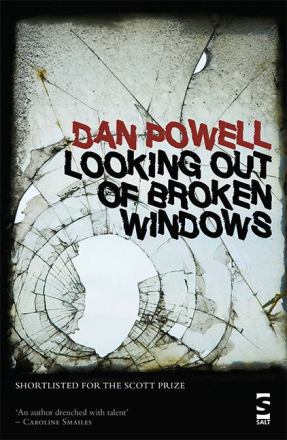
Looking Out of Broken Windows to be published in 2014

2008 was the year I finally decided, after years of not writing and half-writing, to get my act together and really do the thing I have most wanted to do since I was a teenager – write. To that end I signed up for an OU course starting in May of that year. The idea was simple. Sign up on the course and use it to get some feedback on my work. See if pursuing this writing lark was really worth my time. If I did well on the course then chances are I had something worth nurturing. I did well enough on the first course to sign up for more over the next two years. The feedback from my tutors gave me the confidence to start subbing my work. Fast forward to now and I am knee deep in an MA, up to my neck in a novel-in-progress, and have a whole load of published short stories.

And this week, about five years to the day since I started that original OU course, I heard that Salt Publishing will publish my Scott Prize short-listed collection, Looking Out of Broken Windows, in 2014. Longtime readers will know what a fan I am of Salt’s short fiction list. Having my debut collection published by Salt has been a goal of mine since discovering their books back in the early days of this blog. Next year can’t arrive fast enough.

For anyone interested to hear more, you can read all about the writing of my collection in my Scott Prize shortlist post over on the Salt blog.

Winner of 2013 Scott Prize announced

For those of you that haven’t already heard, the winner of the Scott Prize was announced over the weekend. As one of the shortlisted authors I spent a nervous Friday and half of Saturday awaiting the result, which appeared on Twitter a little after lunch:

As you can see, the brilliant Kirsty Logan won and her collection The Rental Heart and other Fairytales will be published by Salt later this year. Having enjoyed each of the Scott Prize winning collections I have so far read, I am very much looking forward to it. ‘The Rental Heart’ was one of my favourites from The Best British Short Stories 2011 and if the rest of the collection is half as good, it’ll be a corker.

Sunday Review – The Drowning of Arthur Braxton by Caroline Smailes

The-Drowning-of-Arthur-Braxton_cover

The latest novel from the ever lovely Caroline Smailes, with its powerful mix of gritty realism and Greek mythology (it retells the classic myths of Apollo and Daphne, Medea and Jason, Castor and Pollux), is a tragic love story of epic proportions that manages to be at once authentic in its portrayal of teenagers and dazzling in the imaginative leaps that power the story to its inevitable and heart breaking ending. And that’s not a spoiler by the way, or if it is then the title’s the biggest spoiler of all.

Arthur Braxton is a young man with problems. His mum’s run off with an old flame and his dad’s lost the plot. He’s bullied at school and a girl he fancies just tricked him into showing her his cock and now the picture is all over Facebook. Walking the streets near the derelict Victorian swimming baths, named The Oracle, he finds himself drawn inside by the irresistible sound of singing and finds himself transfixed by the sight of a naked girl floating in the water. From this point on his life will never be the same.

The story of Arthur, following his discovery of Delphina and her strange companions in the derelict pool, is told in variety of voices and styles. Arthur’s perspective is delivered in a vibrant first person that perfectly captures the tone and preoccupations of the adolescent male, while the tragic figure of Laurel, who narrates the opening of the novel as well as a key section later in the book, provides a powerful counterpoint to Arthur’s voice, full of aching similarities even as her own tragic story plunges into ever darker territory. Sections written in the style of a play script, fitting in light of the stories Greek inspirations, help to lighten the story at times, with the comic pair of Kester and Pollock coming across like Statler and Waldorf as they shout down from the spectator seats surrounding the Males 1st Class pool.

The setting of the Oracle itself is drawn so vividly as to almost become a character itself. We see it in use during Laurel’s sections and in various states of abandoned disrepair during Arthur’s, while the central dramatic script sections fill in what we cannot see through the eyes of these characters. In her afterword, Caroline Smailes talks about the inspiration for her setting, Victoria Baths on Harsage Road in Manchester. It is a testament to her descriptive skills that, on taking a look at the place via the internet after finishing the book, I was struck by how closely the photographs resembled the fictional Oracle I now have in my head.

Last night, with about a quarter of the book left to read, I found myself reading just one more chapter before going to bed. Then just one more. Until, desperate to find out just how Arthur meets the end promised by the book’s title, I flew right through to the final, gripping lines. If you’ve read any of Caroline Smailes other novels, you will know she is an author who does not pull her punches and the ending of The Drowning of Arthur Braxton is no exception. This is a compelling book, from a compelling author. Since finishing this latest work I have not quite been able to shake Arthur and Delphina from my thoughts, every time I think they have retreated to the depths, they burst the surface once again. Like all great tragic romances, it seems they live forever in their story.